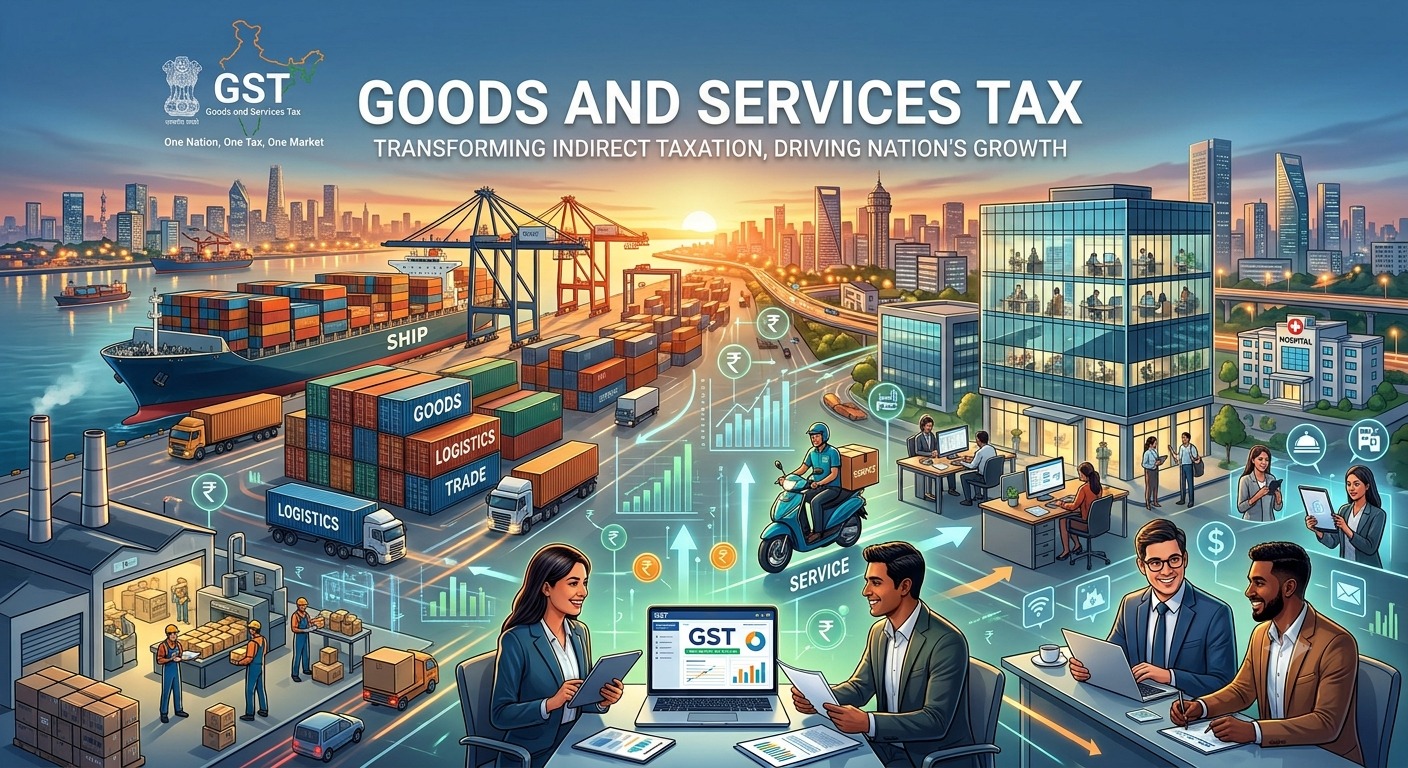
GOODS AND SERVICE TAX GST
Scrap and waste assets are frequently sold without sufficient documentation, making it difficult to apply accurate GST rates. Instead, GST is charged in one lump payment on these items. This means that GST is levied at the highest rate applicable to any item in the composite sale. This strategy simplifies the tax process but may result in a larger tax burden.
Who does it apply to?
Registered Seller
A registered person disposing of scrap will generally have to charge GST on the supply unless it falls under exempt categories.
Registered Buyer
If the scrap disposal is by an unregistered seller, then the recipients are liable to pay GST under the Reverse Charge Mechanism on which they can claim ITC.
According to Section 31 of the Central Goods and Services Tax (CGST) Act, 2017, every registered person who supplies taxable goods (scrap here) is required to issue a tax invoice before, or at the time of:
Removal of goods for supply to the recipient, where the supply involves the movement of goods.
Delivery of goods or making goods available to the recipient, in other cases.
At times when you are supplying scrap on an approval basis, you can issue a delivery challan before issuing the tax invoice. The delivery challan will accompany the goods during transportation to the recipient's premises.
Tax Treatment: Scrap is not defined by GST laws. And its disposal is a taxable supply. GST is charged regardless of whether the scrap is sold, disposed of, or transferred.
High GST Rates: Scrap sales sometimes include various materials, each with a unique GST rate. The highest rate that applies to any item in the combined/composite supply is used for calculating the GST on scrap disposal.
Invoicing: Businesses need to issue tax invoices or bills of supply for scrap sales as per Sec. 31 and Rule 46 of CGST Act, 2017
input Tax Credit (ITC): If scrap is used in the normal course of business and the buyer is registered under GST, the buyer using it for further business may be eligible for an input tax credit on the GST paid.
Compliances for GST on SCRAP
Tax Invoice:
II. Delivery Challan:
A delivery challan is issued during the sale of scrap when goods are sent for approval or other specific purposes.
This is followed by issuing a tax invoice on the receipt of the goods.
III. E-Way Bill:
An e-Way Bill is required to transport scrap from one place to another under GST regulations if the consignment value exceeds ₹50,000.
An e-Way Bill is mandatory if scrap is being transported inter-state or intra-state
IV. Reversal of Credit: Selling Capital Goods as Scrap
When selling a manufacturing machine or capital goods as scrap, reversing the Input Tax Credit is necessary to determine the accurate tax amount.
If capital goods or plant & machinery on which ITC has been taken are sold as scrap, then registered person shall pay (whichever is higher) -Payment = ITC -5% per Qtr. or part thereof
OR
GST on transaction value
In case of refractory bricks, molds & dies, jigs & fixtures supplied as a scrap then person may pay tax on transaction value instead of above 2 options
For more information contact MNRS & Associates | Top CA firm in New Delhi and NCR